

Why Permanent Lighting Makes Sense in Virginia
From the crew at Lights Around — Locust Grove, VA
.
By the first week of December in Virginia, it’s dark before five o’clock. It stays that way until the middle of January. That’s roughly six weeks where you come home in the dark, leave for work in the dark, and see your house lit — or not lit — every single evening.
That’s the actual case for permanent lighting here, and it has very little to do with Christmas.
We install both permanent systems and seasonal displays across Central and Northern Virginia, and we’ve spent enough Novembers on ladders in freezing rain to have opinions about which one suits which house. This is the honest version: what permanent lighting costs here, how it handles our weather, what your HOA is likely to say, and who genuinely shouldn’t buy it.
What Permanent Lighting Actually Is
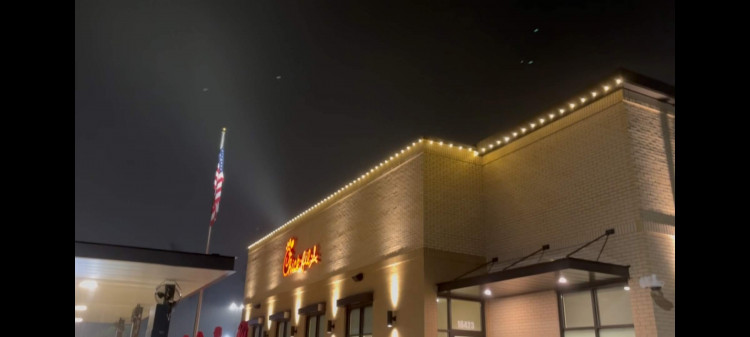
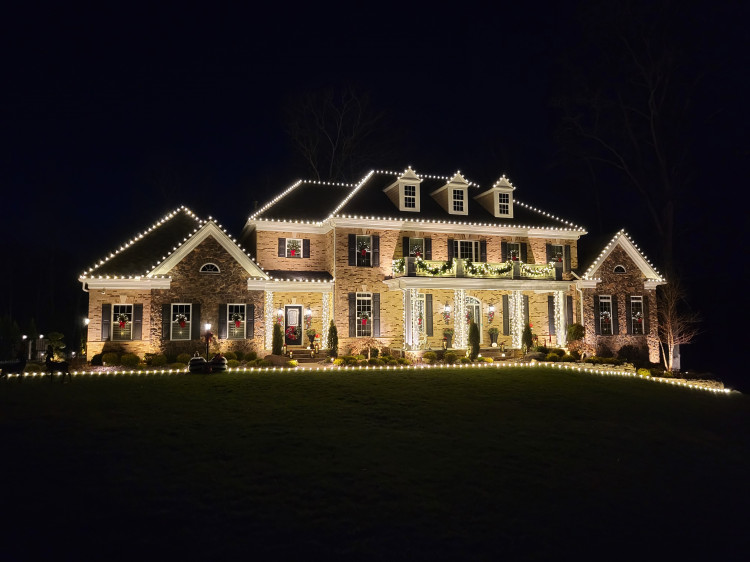
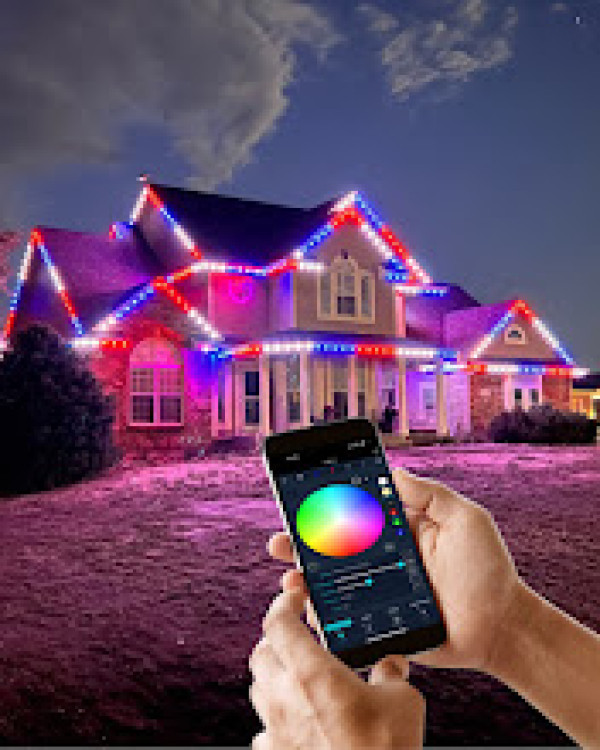
A slim track is installed once along your roofline, tucked into the fascia channel or under the soffit and color-matched to your trim. Inside it sit individually addressable LEDs. A controller and a phone app run everything.
You set it once: warm white from dusk until eleven, every night. Then you change it whenever you want red and green in December, orange in October, red-white-and-blue in July, school colors for a game. It never comes down.
The two objections we hear are “won’t I see it during the day?” and “isn’t that just Christmas lights you can’t take down?” The answer to the first is that from the street it reads as a shadow line along your trim, and there are daylight photos in our photo gallery if you’d rather judge for yourself. The answer to the second is below.
We install it in a few forms: permanent roofline lighting for eaves and gables, permanent LED light bars for a continuous wash on soffits, columns, and flat walls, and permanent patio lighting for outdoor living areas. The full range is on our permanent lighting page.
Virginia Gets Dark Early — for Months
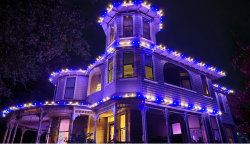
This is the reason that actually holds up, and it’s the one nobody talks about because it isn’t festive.
From early November through late January, most of Virginia is dark by 5:15 or earlier. If you work standard hours, that means you and your neighbors and everyone driving past see your house lit or unlit for the entire evening, five months a year.
A house with a lit roofline at 30% warm white doesn’t look decorated. It looks finished. That’s the effect most of our permanent customers end up valuing most, and it’s the one that makes a Christmas-only product look like poor value by comparison.
Our Weather Is Rough on Seasonal Installs
Virginia doesn’t get consistent deep cold. It gets freeze-thaw — above freezing in the afternoon, below at night, over and over from December to March, often with ice mixed in. That cycle is harder on clips, cords, and connections than a steady cold winter is. Add humid summers and the storage problem: strands that spent eight months in a hot garage rarely come out of the bin the way they went in.
Permanent systems are built for exactly this. Sealed fixtures, weatherproof connections, and a track that’s mounted properly to sound fascia don’t care about freeze-thaw. Nothing gets boxed, nothing sits in a hot garage, and nothing gets re-clipped to your gutters every year which, over a decade, is its own argument.
There’s a safety angle too. Most ladder falls in this industry happen in November and December, on wet or icy surfaces, in fading light. A permanent system means one professionally-managed installation instead of an annual climb.
The Math Works Faster Than People Expect
Nationally, permanent lighting runs about $20 to $40 per linear foot installed, or roughly $2,000 to $8,000 for a typical home. Here’s what it looks like with our actual numbers.
Seasonal installation, per year:
Package | Coverage | Price |
|---|---|---|
75 ft | $940 | |
175 ft | $1,700 | |
275 ft | $2,500 | |
400 ft | $3,200 |
Every one of those includes design, installation, in-season service, removal, and storage — and every one of them recurs annually.
Design Inclusion
Every one of those includes design, installation, in-season service, removal, and storage and every one of them recurs annually.
Permanent lighting, once: our permanent roofline systems start at $3,000 installed, including track, fixtures, controller, wiring, design, and labor, with no annual fee. If the up-front figure is the obstacle, a managed program starts at $900 down plus a monthly fee covering the system, firmware updates, service calls, and repairs. Permanent LED light bars start at $4,000 for up to 100 feet.
The crossover. On a 175-foot roofline, seasonal costs $1,700 a year. Permanent starts at $3,000 once. You’re ahead in year two. On a 400-foot roofline at $3,200 a year, you’re ahead before the second season ends.
That math only works if you’re staying put. Which brings us to the part most companies skip.
Who Should Not Buy Permanent Lighting
We’d rather say this up front than have you find out later.
Don’t buy it if you’re moving within two years. You won’t recover the cost. A seasonal install is the better financial decision and we’ll happily book you one.
Don’t buy it if you rent. It’s a permanent modification to someone else’s building.
Don’t buy it if redesigning the display is the part you enjoy. The track goes where it goes. Colors and effects are unlimited; the layout isn’t. Some people genuinely like changing the whole look every year, and for them seasonal is simply better.
Fix your fascia first if it needs it. If the trim is soft or the gutters are on their last season, handle that before mounting anything permanent to it.
If none of those apply, keep reading.
One System, Every Occasion Virginia Cares About
Permanent lighting stops being a Christmas product about three weeks after installation. What it actually does across a Virginia year:
- Warm white, most nights — the default, and the reason people use it 300 nights a year
- Orange and purple for Halloween, alongside our Halloween lighting
- Red and green in December
- Red, white and blue for Memorial Day, the Fourth, and Veterans Day which lands differently in a state with this many military families
- School and team colors on game nights
- Pink in October for breast cancer awareness we do this as a dedicated event lighting option too
- Whatever a birthday or a graduation party needs, scheduled from the app
For a fuller comparison of the two approaches, we’ve written up permanent vs. temporary holiday lighting separately.
It Makes Even More Sense for Virginia Businesses
For a commercial property, the annual-contractor problem is worse than it is for a homeowner multiple sites, purchase orders, scheduling windows, and a vendor who may or may not be available in the same three weeks next year.
Permanent lighting removes all of it. Brand colors year-round, holiday palettes on a schedule set once, and no seasonal booking. We install retail centers, offices, churches, wineries, HOA common areas, and municipal properties across Virginia to see commercial lighting and our year-round LED systems.
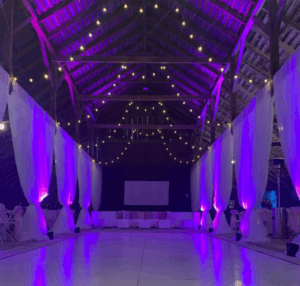
Wineries in Loudoun and Fauquier are a particular fit: outdoor tasting areas that run events well past dark most of the year, where permanent patio lighting does more work than a roofline system does.
What About HOAs and Historic Districts?
This is the Virginia-specific question nobody answers, so here it is properly.
HOAs. Common across Northern Virginia, Loudoun County, Prince William, and newer developments around Fredericksburg and Richmond. Most covenants that address exterior lighting regulate color and operating hours rather than banning permanent systems — a board that’s fine with warm-white architectural lighting may still restrict how long you can run holiday colors. Read your covenants, and submit before you order rather than after. We prepare HOA documentation regularly and can tell you what boards typically ask to see.
Historic districts. If your property sits in the Old and Historic Fredericksburg District, exterior alterations go before the city’s Architectural Review Board and generally require a Certificate of Appropriateness. Old Town Alexandria, Charlottesville, and several other Virginia localities have comparable review processes. This is not a no — plenty of historic-district properties have permanent lighting — but it is a step, and it takes time. If your home is in one of these districts, budget for the review before you budget for the install, and talk to us early so the design accounts for it.
Rule of thumb: the more discreet the daytime appearance, the easier the approval. Soffit-mounted runs are the easiest to get through review because the fixture isn’t visible from the street at all.
What Installation Actually Looks Like Here
Timing matters in Virginia. We book from September, and November fills up — for seasonal work especially, but permanent installs compete for the same crew calendar. Permanent lighting is genuinely easier to schedule in spring and summer, when we’re not racing daylight and the weather cooperates.
The process. Site visit and roofline measurement first, then a design against a photo of your actual house so you can see it before you commit. Installation typically takes one to two days depending on roofline length, height, and access. We run the wiring, mount the track, install the controller, configure your zones, and walk you through the app before we leave. We handle permits and HOA paperwork where a community requires it, and we clean up everything we bring.
That’s what “we take care of everything design, installation, maintenance, and takedown” means in practice. You can read more about how our all-inclusive model works.
Where We Install Across Virginia
Not on the list? Check the full service area map or just ask — we regularly install outside the named towns.
Frequently Asked Questions
Are permanent Christmas lights worth it in Virginia?
For most homeowners staying in their house more than two or three years, yes. Seasonal installation here runs $940 to $3,200 a year depending on roofline length; permanent starts at $3,000 once. The break-even usually lands in year two or three, and everything after that is free. The bigger return is the 300-odd nights a year you use it that have nothing to do with a holiday.
How much does permanent outdoor lighting cost in Virginia?
Our permanent roofline systems start at $3,000 installed with no annual fee, or $900 down plus a monthly fee on our managed program. Nationally, permanent lighting runs roughly $20–$40 per linear foot installed. Final price depends on roofline length, home height, and access.
Will permanent lights survive Virginia winters?
Yes. The fixtures, track, and connections are sealed and rated for outdoor use through snow, ice, and repeated freeze-thaw cycles — which is the pattern that matters here more than absolute cold does. LED output is unaffected by low temperatures.
Can you see permanent lights during the day?
Barely. The track mounts flush in the fascia channel or under the soffit and is color-matched to your trim, so from the street it reads as a shadow line. Soffit-mounted runs aren’t visible from the street at all.
Will my HOA allow permanent lighting?
Usually, though many Northern Virginia and Loudoun County covenants regulate color and operating hours. Check yours and submit before ordering. We prepare HOA documentation routinely.
What if my house is in a historic district?
Exterior alterations in districts like Old and Historic Fredericksburg typically require review by the Architectural Review Board and a Certificate of Appropriateness. It’s usually approvable — discreet, soffit-mounted designs have the easiest path — but budget time for the process and talk to us before you order.
How long do permanent LED lights last?
The LEDs are rated in the tens of thousands of hours, which is well over a decade at normal evening run times. The controller and power supply are the first components likely to need service, and both are replaceable without disturbing the track.
Can I still decorate for Christmas?
Yes. Permanent lighting handles the roofline only. Tree wraps, wreaths, garland, and shrub lighting are all unaffected, and most of our permanent customers still add seasonal pieces in December.
When should I book?
Any time, but earlier is better. We book from September and November fills up. Spring and summer are the easiest windows for a permanent install.
Do you install on commercial buildings?
Yes retail, offices, churches, wineries, HOAs, and municipal properties are a large share of our permanent work. See commercial lighting.
See It on Your Own House First
Send us your address and a photo of the elevation you want lit. We’ll come back with a design against your actual house and a fixed price for permanent, for seasonal, or for both, so you can compare them side by side without guessing.
Get a free design and quote or call (703) 634-6008.
Browse recent Virginia installs in our photo gallery, read what local homeowners have said in our reviews, or see who we are.
Lights Around · 3494 C Germanna Hwy, Locust Grove, VA 22508 · (703) 634-6008
