

Christmas Lights Outdoor Installation Near Me: How to Find the Right Local Installer
Introduction
Every year around the first cold week of November, the same thing happens on driveways across Virginia. Someone looks up at their roofline, thinks about the ladder in the garage, and pulls out their phone to search for Christmas lights outdoor installation near me.
If that is you, this guide is written to answer the questions that search actually carries: what a professional installer does, what kind of lights you should be asking for, how to tell a good local company from a truck with a ladder, what it costs, and what happens on the day the crew shows up. We install across Central and Northern Virginia, so some of the examples are local. Most of the advice holds wherever you live.
Importance of Holiday Lighting
Holiday lighting is the one home improvement that everybody on your street gets to enjoy. It turns a house into a landmark for the season, it makes the walk from the car to the front door feel like an arrival, and for a lot of families it is the backdrop to the photos that end up on the mantel. Lighting also changes how a home reads at night. A dark house in December disappears; a lit one looks cared for and lived in. That is why neighbors notice, why real estate agents ask sellers to keep displays tasteful but present, and why businesses that light their storefronts tend to see more foot traffic in the weeks before Christmas.
Benefits of Professional Installation
Hiring it out buys you four things you cannot get from a box of lights. The first is safety: nobody in your household goes up a ladder onto a wet or frosted roof. The second is the look. Installers measure every run, cut strands to fit the roofline exactly, and clip lights to the surface so the display looks like it belongs on the house rather than draped over it. The third is time. A crew does in an afternoon what takes most homeowners two weekends. The fourth is the part people forget: takedown. With a full-service installer the lights come down on a scheduled January date, get packed properly, and go into storage that is not your garage. If you want the longer version of that argument, we wrote about the five reasons to hire a professional Christmas light installer.
Understanding Christmas Lights Outdoor Installation
Before you call anyone, it helps to know what you are choosing between. “Outdoor Christmas lights” covers a wide range of products, and the type you pick changes the look, the running cost, and what the installer can guarantee.
Types of Christmas Lights Available
Most professional displays are built from a handful of elements, and each one does a different job.
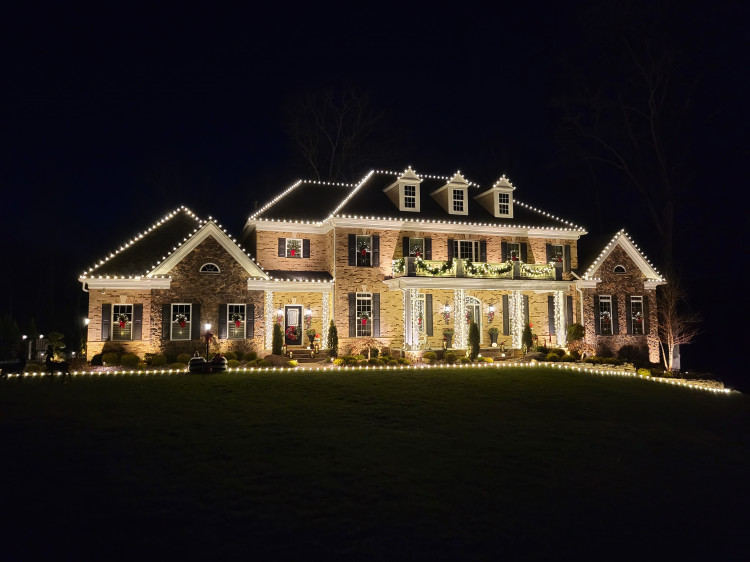
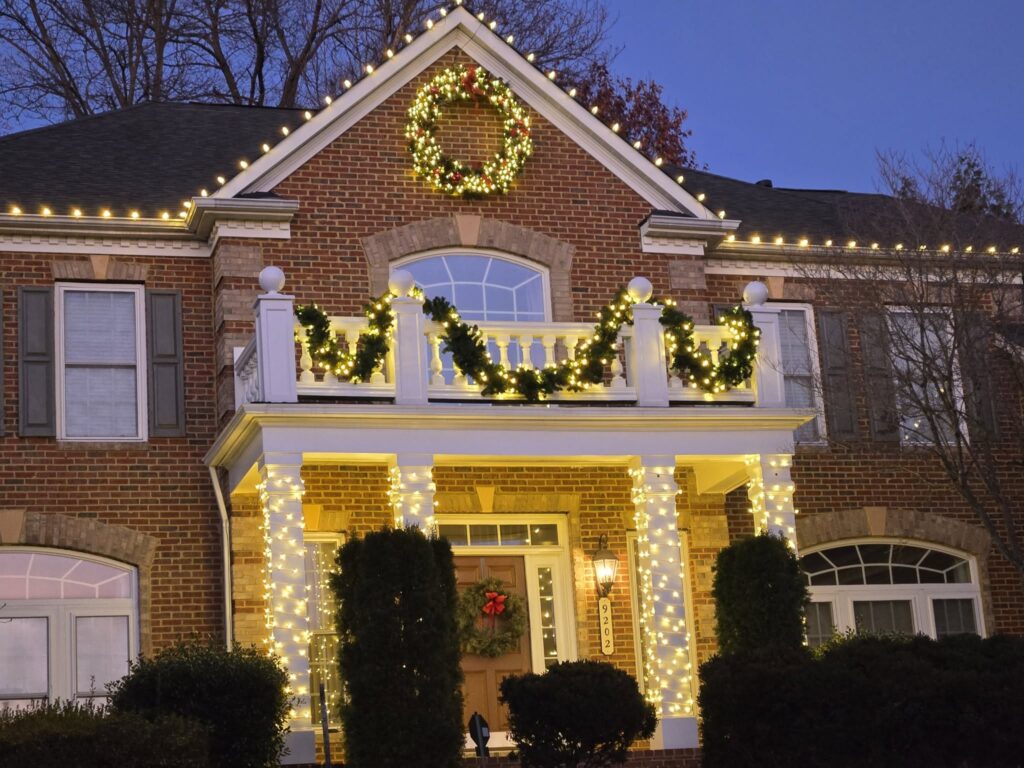
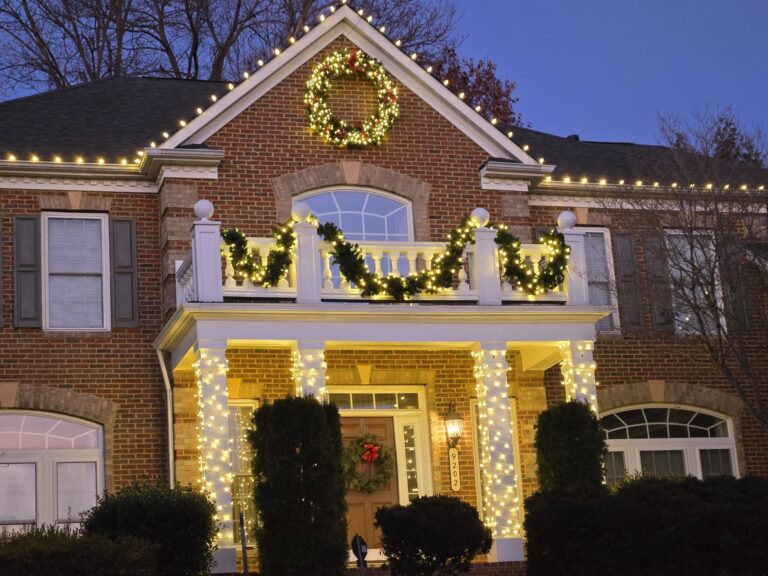
Roofline lights are the backbone. Large C9 bulbs traced along the gutters, peaks, and eaves outline the shape of the house, which is why a clean roofline in warm white often looks better than a yard full of mixed decorations. Our roofline Christmas lights packages start at around 75 feet and scale up to 400 feet for larger homes.
Tree wraps add depth. A front-yard maple with a wrapped trunk stops the display from being a flat line across the top of the house. Tree light wraps are priced by tree size, so they show up as a separate line on a quote.
Wreaths and garland frame the entry, which is the part guests photograph and the part you walk past every day. Lit wreaths and garland do a lot of work for what they cost.
Pillar wraps and ground lights fill the lower half of the picture. Pillar light wraps dress porch columns and gate posts, and ground lights keep the display from floating above a dark yard.
You can browse the full range on our Christmas lights rental page.
Energy-Efficient Outdoor Christmas Lights
If a company is still installing old-style incandescent strands, keep looking. Energy-efficient outdoor Christmas lights are LED, and the difference is not small. According to the U.S. Department of Energy, LED holiday light strings use far less electricity than incandescent ones, run cooler to the touch, last many seasons longer, and are far more durable because there is no filament or glass bulb to break. The DOE estimates that lighting a six-foot tree for 12 hours a day over 40 days costs a fraction with LEDs of what it costs with incandescent bulbs, and the same math applies to a roofline. You can read the details on the Department of Energy’s page on LED holiday light strings.
For a homeowner, that means a bigger display for the same power bill, less heat against your shingles and gutters, and far fewer strands that die between one season and the next. Every light we install is LED, and because we own the inventory, a strand that dims or drifts in color gets swapped rather than left on the house.
Traditional vs. Modern Options
Traditional lighting is the seasonal display most people picture: lights go up in November, come down in January, and get stored until next year. It is flexible, you can change the look from one season to the next, and it costs less up front.
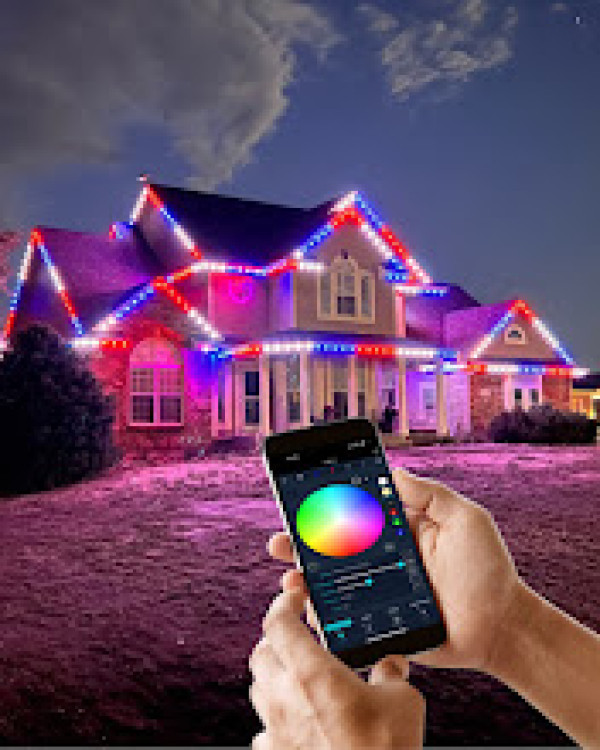
The modern option is permanent lighting. A low-profile track sits under the eave year-round with color-changing LED bulbs you control from your phone. In daylight it is close to invisible. At night it can be warm white for everyday use, red and green in December, orange in October, or team colors on game day. It costs more at the start, but there is no annual booking, no takedown, and no storage. Our permanent lighting page walks through how the year-round lighting system works, and color-changing C9 roof lights are also available as a seasonal rental if you want the app-controlled look without committing to a permanent install.
Which one is right for you comes down to one question: are you staying in the house? If yes, and you already hire installation every year, permanent lighting usually pays for itself within a few seasons. If a move is likely, or if changing the look every year is half the fun, traditional seasonal installation is the better value.
Finding Local Services
Now the part that the search is really about: who is going to do the work.
How to Search for “Christmas Lights Outdoor Installation Near Me”
The search results for a phrase like outdoor christmas light installation near me are usually a map with three or four companies pinned on it, followed by directory sites like Yelp, Angi, and Thumbtack, then individual company websites. Here is how to use them well.
Start with the map. Companies that show up there have a verified business address and, usually, a track record of reviews. Open each profile and check three things: how many reviews they have, how recent the reviews are, and whether the address is actually near you. A company two hours away can still show up on the map, and distance matters more in this trade than in most.
Then try a couple of variations. Searching for outdoor christmas lights installation near me or outdoor christmas lights installers near me will often surface different companies, because each business optimizes its website for slightly different wording. Add your town name, too. A search like “christmas light installation Fredericksburg VA” pulls up companies that actually work in your area rather than ones that just happen to rank statewide.
Finally, skip the directory sites for the actual booking. They are fine for finding names, but the quote you get through a lead form on a national directory is usually a rough estimate from someone who has not seen your house. Go to the company’s own site and use its contact form or phone number.
Key Factors in Choosing Installers
Once you have a shortlist of two or three companies offering christmas outdoor light installation near me, these are the questions that separate them.
Insurance. Somebody is going to be on a ladder at height on your property. Ask for the certificate, not the reassurance. We keep ours on our insurance page so you do not have to ask.
Who supplies the lights. Most established companies install their own commercial-grade LED lights rather than hanging strands you bought at a big-box store. That is what lets them guarantee the display, match a replacement exactly, and keep colors consistent from one season to the next.
What happens when something goes dark. Something will, at some point between Thanksgiving and New Year’s. A connection takes on water, a squirrel finds a cord, a bulb gives out. The question is whether a truck comes out and whether that visit is included. Ours is; our FAQ page spells out how it works.
Takedown and storage. Ask whether they are in the price or billed separately. A quote that leaves them out is not really cheaper.
Local knowledge. A crew that works your area knows which neighborhoods have HOA rules about color and timing, knows that a historic block in Fredericksburg calls for something different from a new build in Loudoun County, and can actually get to you on a weeknight in December when a run goes out. You can check whether we cover your town on our service areas page.
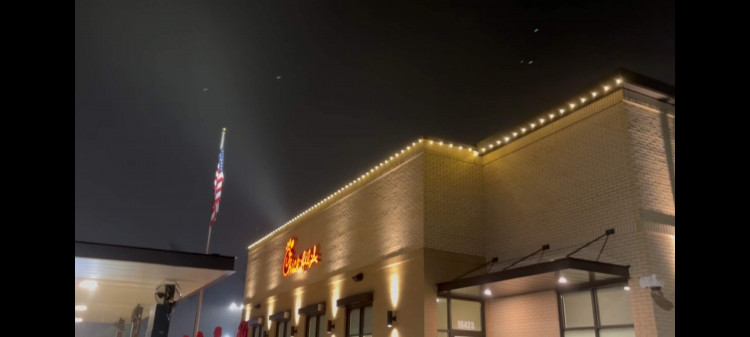
Range of work. Some companies only do rooflines. If you want trees, wreaths, and the entry done in one visit, or you are a business that needs something larger, look for a company that offers full residential outdoor lighting services alongside commercial work. Our commercial lighting page covers tower trees, giant light-up bulbs, and displays for storefronts, HOAs, and venues.
Reviews and Recommendations
Reviews tell you more than a website does, but read them the right way. Look for reviews that mention specifics: a crew showing up on time, a service call handled quickly, a display that looked the same in year three as in year one. Be cautious when every review appeared in the same week, or when the reviews praise the company but never describe the work.
Ask around, too. Neighbors with a display you like are the single best source of a recommendation, and a company that has lit four houses on your street already knows the roof pitches and the HOA. You can read what our customers say on our reviews page, and our photo gallery shows the actual homes behind those reviews.
Pricing and Packages
Most professional companies price outdoor Christmas light installation by the linear foot of roofline, then add trees, wreaths, and other elements as separate items. Nationally, that works out to a few hundred dollars for a small single-story roofline and a few thousand for a large two-story home with trees and ground lighting.
We publish our prices rather than making you ask. Our residential roofline packages run from the Elf package at $940 for up to 75 feet, through the Rudolph (up to 175 feet, from $1,700) and Santa (up to 275 feet, from $2,500) tiers, to the North Pole package at $3,200 for up to 400 feet. Tree wrapping ranges from $150 to $1,475 depending on tree size, and wreaths, garland, pillar wraps, and window lights run from $75 to $400. Every quote includes design, the lights themselves, installation, service calls during the season, takedown, and storage. There is no separate removal bill in January.
Two things to know about pricing. First, the number is driven mostly by footage and height: a second story roughly doubles the labor on the same length of roofline, and a steep pitch adds time and fall protection. Second, year two costs less than year one. Once your house is measured and the strands are cut to your rooflines, the conversation becomes “same as last year, plus the two trees by the driveway.”
The Installation Process
People are often surprised by how little they have to do. Here is what actually happens from the first call to the first night the lights come on.
Steps Involved in Outdoor Christmas Light Installation
The process runs in five steps: an initial conversation and site visit, a design and written quote, a scheduled installation day, service through the season, and a scheduled takedown in January. The whole thing usually involves a handful of messages a year once you are a returning customer.
Timing matters. Booking opens in September and early October, and returning customers renew first. Design visits happen through October, and most homes go up between the first of November and Thanksgiving. If you wait until December, you will still likely get a slot, but you will have less say over the date, and the evenings before a weekend go first.
Initial Consultation and Design
The first visit is a walk around the property. The installer measures every run of roofline, looks at the trees, the entry, the power sources, and the surfaces the clips will attach to, and talks with you about what you want the house to look like from the street when you pull into the driveway.
Then comes the design. This is the step that separates a house with lights on it from a lit house. Decisions about spacing, symmetry, where a run starts and stops, and what deliberately stays dark all get made before anyone opens a ladder. You get a written quote listing every element, so you know exactly what you are paying for and can compare it line by line with any other quote.
Actual Installation Day
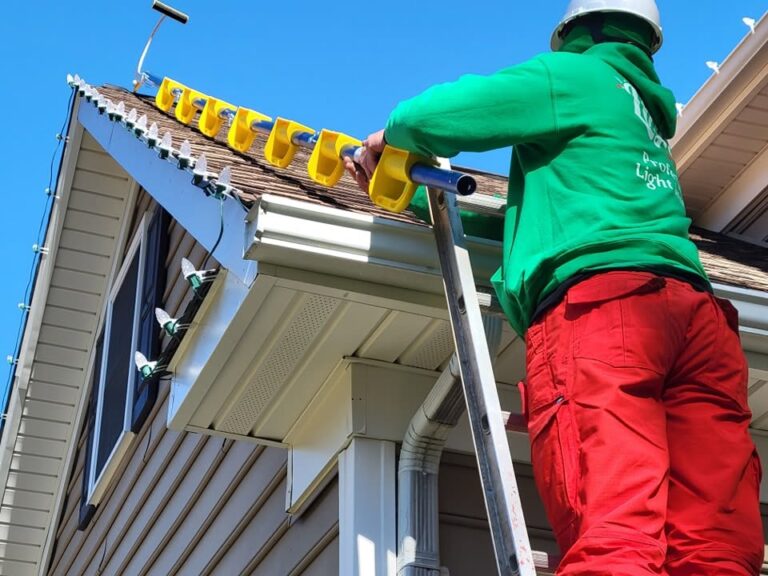
On installation day a crew of two or three arrives with lights already cut to your measurements. A single-story home usually takes half a day; a larger two-story property takes a full day. The crew uses clips matched to each surface, since gutter, shingle, brick, and fascia all take different hardware, and routes cords so your eye goes to the light rather than the wiring. Timers are set so the whole display comes on and goes off together.
A quick word on safety, because it is the reason most people hire this out. The U.S. Consumer Product Safety Commission publishes guidance on seasonal and decorative lighting covering what to check before anything goes on a house, and the U.S. Fire Administration’s holiday fire safety page notes that a large share of home Christmas tree fires begin with an electrical problem. A professional crew inspects every strand, respects the manufacturer’s limit on how many strands connect end to end, and uses outdoor-rated cords and timers. Those are the details that get skipped on a cold Saturday afternoon with a ladder.
Before the crew leaves, they test the display, confirm the timer schedule with you, and leave a number to call if anything goes dark during the season. In January they come back on a scheduled date, take everything down carefully, and take it away.
Conclusion
Recap of Benefits
Hiring a professional for outdoor Christmas light installation gets you a display that is designed for your house rather than draped over it, built from energy-efficient LED lights that cost less to run and last longer, installed by a crew that carries insurance and knows how to work safely at height, and backed by service calls through the season. Takedown and storage are handled, so nothing ends up on a shelf in your garage. And because pricing is by the foot and packages are published, you know what it costs before anyone shows up.
Encouragement to Hire Local Experts
The “near me” part of your search matters more than it looks. A local company knows your neighborhood, your HOA, and your weather, and it can get to your house on a weeknight when one run goes dark. Our crews work out of Locust Grove, which puts Fredericksburg, Woodbridge, Manassas, Fairfax, Loudoun County, Culpeper, Richmond, Charlottesville, and Lynchburg inside a comfortable drive, and we carry local numbers in the 703, 540, 804, and 434 areas for that reason.
If you have been going back and forth on this, the easiest next step is a conversation. We walk the property, talk about what it should look like from the street, and put a fixed plan together. Get in touch with Lights Around to book your outdoor Christmas light installation, or check the service areas page first to confirm we cover your town.
